What Is a WhatsApp Drip Sequence?
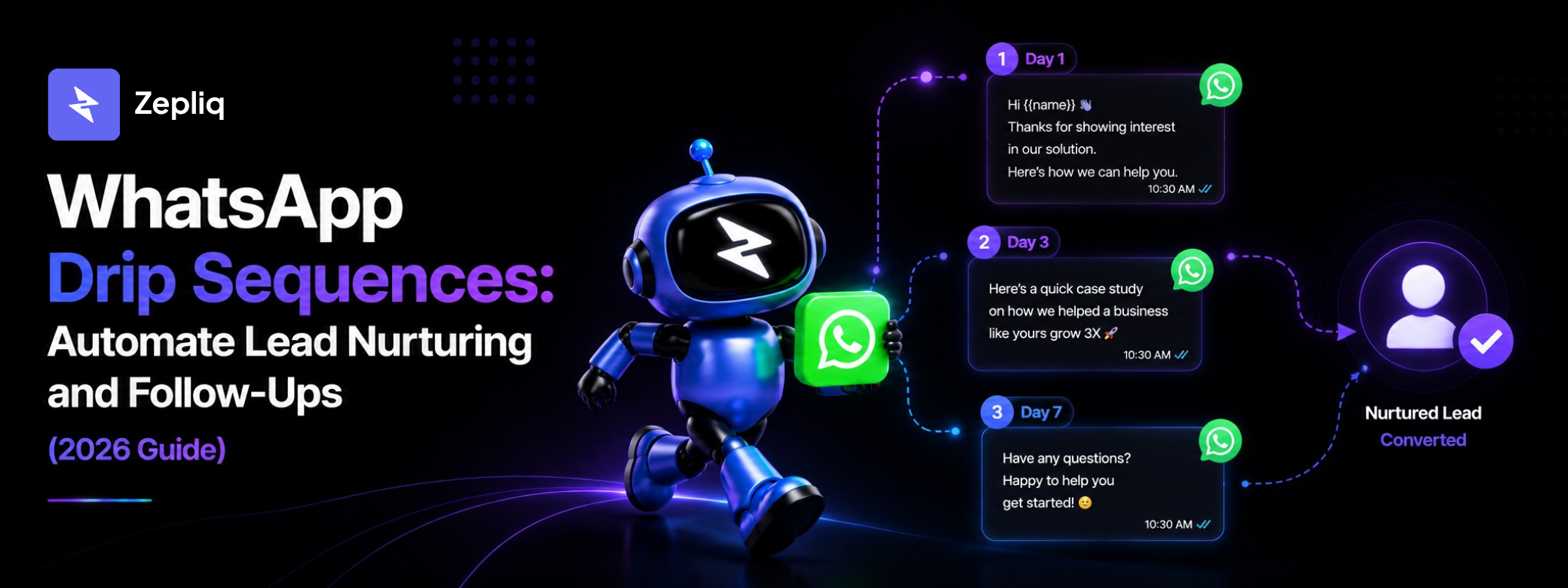
A WhatsApp drip sequence is a series of automated messages sent to contacts over a defined period. Each message is triggered by time, behavior, or conversation stage. Together they guide the recipient from initial interest toward a purchase, booking, or decision.
Unlike a broadcast, which sends one message to many people at once, a drip sequence is personalized to where each individual contact is in the journey. A new lead receives different messages than an existing customer or a dormant prospect.
The term "drip" comes from drip irrigation — the idea of delivering exactly what a contact needs, when they need it, without overwhelming them. In marketing, that means spacing messages over days or weeks so each one arrives when it is most relevant.
Drip sequences work across every stage of the customer lifecycle: welcoming new leads, nurturing undecided prospects, recovering abandoned carts, onboarding new customers, collecting reviews, and re-engaging dormant contacts. Each scenario uses the same underlying mechanic but a different message cadence and goal.
Why WhatsApp Beats Email for Drip Campaigns
Email drip campaigns have declining open rates — often below 20 percent. WhatsApp messages consistently reach over 90 percent of recipients within minutes. This single difference is the core reason businesses are moving lead nurturing from email to WhatsApp.
WhatsApp drip sequences also benefit from two-way communication. When a lead replies at any point in the sequence, the conversation becomes interactive. AI can answer questions in real time, which means drip nurturing and live support operate from the same channel simultaneously — something email cannot replicate.
The channel itself creates trust. A WhatsApp message from a business feels personal in a way that email does not. Customers read WhatsApp messages on their phones, in the same place they message family and friends. That context raises engagement rates far above any other digital channel.
- 90%+ open rates vs 20% for email drip campaigns
- Messages are read within 3 minutes on average — email averages 6+ hours
- Replies are instant — leads can ask questions at any point in the sequence
- Works on mobile where most prospects check messages throughout the day
- AI handles replies automatically without breaking the drip flow
- Sequences can be paused or altered in real time based on customer replies
- No spam folder — WhatsApp messages land directly in the chat
How to Build a WhatsApp Drip Sequence Step-by-Step
A well-built drip sequence has four components: a trigger (what starts it), a series of messages (what gets sent), timing rules (when each message goes out), and exit conditions (what stops it). All four need to be configured before the sequence goes live.
For most businesses, the trigger is a new lead opting in through a form, WhatsApp link, or Click-to-WhatsApp ad. The sequence then runs automatically until the lead converts, opts out, or a human agent takes over.
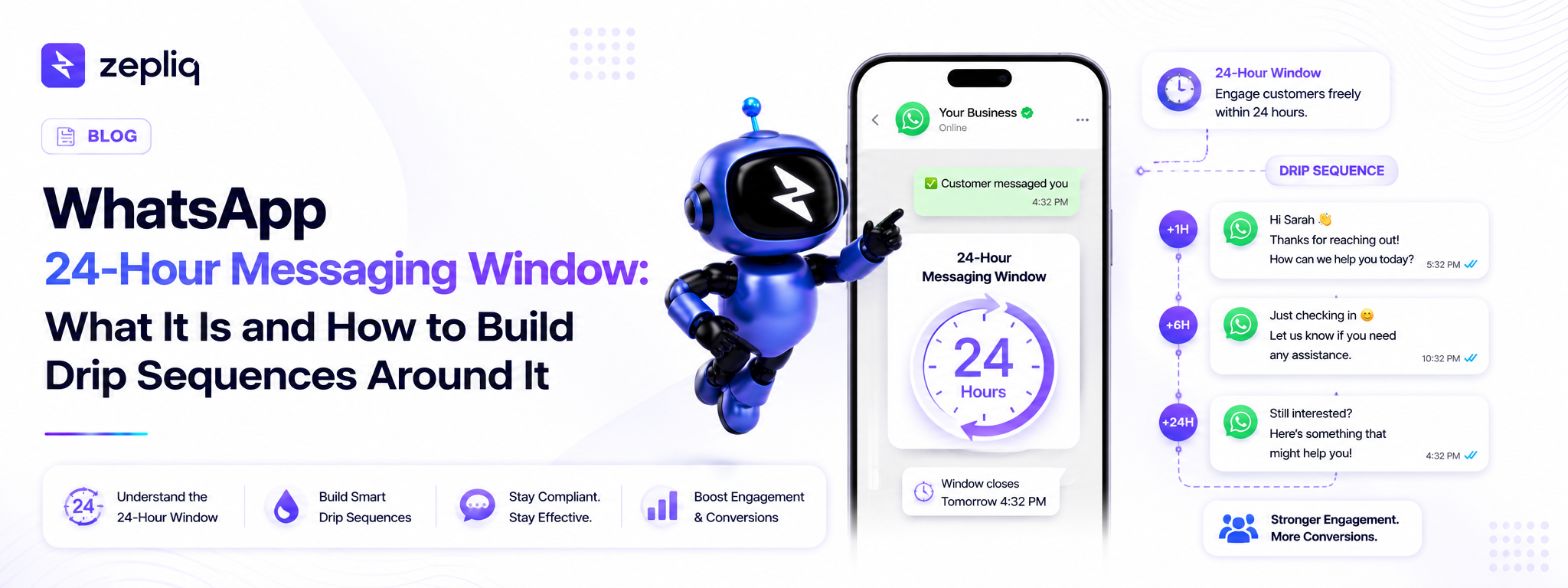
Every message outside the 24-hour conversation window must use a Meta-approved template. Zepliq handles template submission and approval as part of setup, so you build the sequence and the platform ensures every outbound message complies with WhatsApp policy.
- Step 1 — Define the trigger: new lead, new order, no reply after X days, or custom event
- Step 2 — Write the sequence: 3 to 7 messages covering introduction, value, proof, and offer
- Step 3 — Set timing rules: Day 0, Day 2, Day 5, Day 10 — adjust based on your sales cycle
- Step 4 — Create exit conditions: stop when lead replies, purchases, or opts out
- Step 5 — Submit templates for Meta approval via Zepliq (usually approved in under 24 hours)
- Step 6 — Set AI to handle replies between drip messages so leads never wait
- Step 7 — Monitor open rates, reply rates, and conversions per step to optimize over time
WhatsApp Drip Sequence for E-Commerce Stores
E-commerce brands use WhatsApp drip sequences primarily for five scenarios: welcoming new subscribers, recovering abandoned carts, confirming COD orders, re-engaging dormant customers, and collecting post-purchase reviews. Each scenario needs a different sequence with a different goal and tone.
The post-purchase sequence is one of the highest-ROI workflows in e-commerce. After a customer buys, automated follow-ups confirm delivery, collect reviews, and offer complementary products — all without any manual effort from the team. A three-message post-purchase sequence can generate more repeat purchases than a full broadcast campaign.
COD confirmation is especially critical for South Asian and MENA markets where cash on delivery represents 50 to 80 percent of all orders. A WhatsApp drip that confirms COD intent before dispatch reduces returns by 40 to 60 percent according to stores using Zepliq.
- New subscriber sequence: welcome + best-sellers + first-purchase discount (3 messages over 7 days)
- Abandoned cart sequence: reminder + urgency + last-call offer (3 messages over 24 hours)
- COD confirmation sequence: verify intent + send tracking + collect review (3 messages over 3 days)
- Post-purchase sequence: delivery confirmation + review request + repurchase offer (3 messages over 14 days)
- Winback sequence: re-engage customers with 30–60 day purchase gap (3 messages over 7 days)
WhatsApp Drip Sequence for Service Businesses and Agencies
Service businesses — coaching, consulting, real estate, education, healthcare, SaaS — have longer sales cycles than e-commerce. A WhatsApp drip sequence for these businesses needs to build trust over weeks, not hours. The goal is not a purchase on the first touchpoint — it is a conversation, then a call, then a proposal.
The most effective service business sequences follow a consistent pattern: education first, social proof second, direct offer third. Prospects who feel informed before the offer convert at significantly higher rates than those who receive the offer immediately after opt-in.
For real estate specifically, WhatsApp drip sequences have replaced cold calling in many markets. Agents send property updates, area reports, and client testimonials over 2 to 4 weeks before making a direct call-to-action. Conversion from drip to viewing appointment is consistently higher than from cold outreach.
- Day 0: Welcome + what to expect — set the tone without selling anything
- Day 2: Educational tip or insight directly relevant to the lead's stated problem
- Day 5: Case study or client result from their specific industry or situation
- Day 9: Soft offer — free consultation, demo, or assessment with low commitment required
- Day 14: Direct offer with deadline — discount, bonus, or limited availability signal
- Day 20: Final follow-up acknowledging their timeline and keeping the door open permanently
WhatsApp Drip Sequence Templates (Copy-Paste Ready)
These templates follow the proven pattern: welcome, value, proof, offer, follow-up. Replace the bracketed placeholders with your brand details. All templates must be submitted as Meta-approved templates before use in automated sequences outside the 24-hour window.
- Day 0 (Welcome): "Hi [Name], welcome to [Brand]! I'm here to help you [achieve goal]. Here's what to expect: [1-line description]. Reply anytime — we respond fast."
- Day 2 (Value): "Hi [Name], here's something that helped similar [industry] businesses: [specific tip or stat]. Does this apply to your current situation?"
- Day 5 (Social Proof): "Hi [Name], [Customer Name] from [City/Industry] achieved [specific result] using [Product] in [timeframe]. Want me to share the details?"
- Day 8 (Offer): "Hi [Name], ready when you are: [offer details + link]. This pricing/bonus is available until [date]. Questions? Just reply here."
- Day 12 (Last Follow-Up): "Hi [Name], last message from us — we don't want to crowd your inbox. If now isn't the right time, you can always reach us at [contact]. Take care!"
5 WhatsApp Drip Sequence Mistakes That Kill Conversions
Most failed drip sequences share the same avoidable mistakes. Understanding what not to do is as important as knowing the right templates and timing. These are the five most common errors Zepliq sees across thousands of WhatsApp automation workflows.
- Sending too many messages too fast: more than one message per day trains contacts to block your number — space messages at least 48 hours apart in the first week
- Starting with the offer: leading with a discount before building any value signals desperation and reduces trust — always lead with a benefit or insight first
- Sending freeform messages outside the 24-hour window: this violates Meta policy and can suspend your WhatsApp Business account — every drip message needs an approved template
- No exit conditions: contacts who purchase, reply "stop", or become customers must be removed from the sequence immediately — unmanaged sequences damage your account quality score
- Identical messages to all segments: a new lead and a dormant customer need completely different sequences — sending the same messages to both destroys relevance and conversion rates
How to Measure and Optimize Your WhatsApp Drip Sequence
A drip sequence is never finished — it improves continuously as you collect reply data, conversion events, and opt-out rates. The metrics to track are different at each step, and problems at one step do not always mean the whole sequence needs to change.
Zepliq provides per-step analytics including delivery rate, read rate, reply rate, and conversion events. Use this data to identify which specific step is underperforming before making any changes. Changing a working step to fix a problem at step 4 is one of the most common optimization mistakes.
- Delivery rate below 90%: contact quality issue — clean your list and verify opt-in compliance before scaling
- Read rate below 70%: message timing or first sentence needs improvement — test different send times
- Reply rate below 5% at step 1: the welcome message is not compelling — add a specific question or clear benefit statement
- Drop-off at step 3 or 4: sequence is too long or repetitive — test a shorter version with 3 messages first
- High unsubscribe rate: messaging frequency is too high or content is irrelevant — reduce cadence and improve targeting
- Conversion only at step 4–5: your offer timing is correct — do not move it earlier based on impatience
Frequently Asked Questions
How many messages should a WhatsApp drip sequence have?
Most effective sequences have 4 to 7 messages. Too few and you under-nurture the lead before they are ready to buy. Too many and you risk opt-outs that damage your WhatsApp account quality. Start with 5 messages and adjust based on reply and conversion data from your first 100 contacts.
Can I personalize each message in the sequence?
Yes. Zepliq supports dynamic variables like first name, company name, product interest, city, last purchase date, and order value in every drip message. Personalized messages consistently outperform generic ones — even a first-name variable alone improves reply rates by 20 to 30 percent.
What happens if a contact replies during the drip sequence?
Zepliq's AI handles the reply in real time. The drip sequence continues on schedule unless the contact explicitly asks to stop, makes a purchase, or the conversation is escalated to a human agent. This means the lead gets an immediate response AND continues to receive the sequence — the two are not mutually exclusive.
Can I run different drip sequences for different segments?
Yes. Zepliq lets you create separate sequences for new leads, existing customers, dormant contacts, post-purchase follow-ups, and any custom segment. Each segment receives messages relevant to their specific stage and history with your business.
Do I need the WhatsApp Business API for drip sequences?
Yes. The WhatsApp Business App does not support automated sequences or bulk messaging. You need the WhatsApp Business API, which Zepliq connects for you without any developer required. Most businesses complete setup and send their first automated sequence within 30 to 60 minutes.
How do I handle opt-outs during a drip sequence?
Any contact who replies with "stop", "unsubscribe", or similar must be immediately removed from the sequence and added to a suppression list. Zepliq detects opt-out intent automatically and removes contacts from all active sequences. Continuing to message opted-out contacts is a Meta policy violation that can suspend your account.
What is the best time of day to send WhatsApp drip messages?
Between 9 AM and 12 PM local time sees the highest open and reply rates across most industries. Avoid late evenings and very early mornings. For B2C e-commerce, Sunday evenings between 7 PM and 9 PM also perform well. Always test two send windows with a small segment before scaling to your full list.
Can WhatsApp drip sequences work for B2B sales?
Yes, with specific adjustments. B2B sequences run longer (14 to 21 days), use more educational content, and have a softer offer structure — the goal is to secure a call or demo, not a direct purchase. WhatsApp works especially well for B2B outreach in markets where professionals use WhatsApp daily, including South Asia, MENA, and Latin America.
Build Your Customer Automation System with Zepliq
Zepliq helps growing brands automate WhatsApp, email, Shopify, WooCommerce, and sales pipeline workflows from one dashboard.
Use this guide as a starting point, then connect your real customer conversations so your team can reply faster, follow up better, and build a brand customers remember.
Start Your Free 14-Day Trial
No credit card required. Connect your channels and launch your first automation workflow in minutes.
- No credit card required
- WhatsApp, email, and store automation
- Built for sales and support teams
.png)
.png)